

Packaging, Circularity and Producer Responsibility
EU Packaging and Packaging Waste Regulation (PPWR)
The Packaging and Packaging Waste Regulation (PPWR), officially Regulation (EU) 2025/40, sets EU-wide rules for packaging and packaging waste. Its aim is to prevent packaging waste and promote reuse and recycling across the EU. The regulation applies across the packaging lifecycle, from design and production to use and end-of-life treatment, helping to support a more circular approach to packaging throughout the EU.
At Sioen, we recognise that packaging plays an important role in reducing environmental impact across our value chain. We continuously work to optimise packaging solutions while ensuring that products are adequately protected during transport, storage and use. In addition to compliance with the Packaging and Packaging Waste Regulation (PPWR), we fulfil applicable producer responsibility obligations through national packaging and textile take-back schemes across the markets where we operate.
Our approach
We manage our packaging in accordance with applicable European packaging legislation and continuously monitor evolving regulatory requirements.
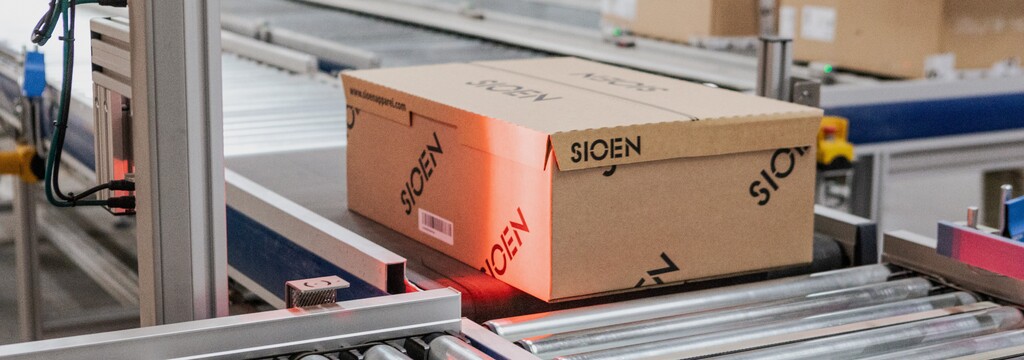
Our current packaging portfolio includes recycled and certified materials. Cardboard boxes used by Sioen contain at least 80% recycled fibre and are supplied under FSC-certified sourcing (certificate SCS-COC-701762). Polyethylene bags used for garment packaging are manufactured from 100% recycled post-consumer LDPE4 and are supported by Global Recycled Standard (GRS) certification. Wooden pallets used within our European distribution activities are based on reused wood streams.
In practice, our approach is based on the following priorities:
- Reducing unnecessary packaging materials where technically and contractually feasible, for example by delivering garments in grouped packaging instead of individual plastic bags, using paper bands to bundle garments and avoiding unnecessary filling material.
- Our Sioen PRO and SIP Protection product ranges no longer use hangtags on the clothing. For more information: No more hangtags
- Adjusting packaging dimensions to the actual volume of the delivery. At our European distribution centre in Moeskroen, automated box-sizing technology reduces cardboard consumption, filling material and transport volume by adapting box dimensions to the actual shipment size.
- Promoting packaging designs that support recycling, resource efficiency and the increased use of recycled materials.
- Monitoring regulatory developments related to packaging composition, substances of concern, recycled content and recyclability.
- Supporting compliance with packaging-related obligations across European markets and continuously strengthening the underlying supplier documentation and compliance records.
- Providing customers with transparent packaging information where required.
Extended Producer Responsibility (EPR)
As a producer placing packaged products and textile products on various European markets, Sioen is subject to Extended Producer Responsibility (EPR) obligations in several countries. To fulfil these obligations, we participate in recognised compliance and take-back schemes where required by national legislation.
For packaging EPR obligations:
- Belgium: Sioen NV is affiliated with Valipac (registration number 1100843300).
- Germany: Sioen is registered through Lizenzero / LUCID (registration number DE1641715080678).
For textile collection and take-back obligations:
- Netherlands: Sioen Nederland participates in Collectief Circulair Textiel (CCT).
- France: Sioen France is registered with Refashion (registration number FR330949_11AOXJ).
Sioen continuously monitors the ongoing implementation of packaging and textile EPR requirements across Europe and adapts its compliance processes accordingly. Information regarding future Belgian textile EPR implementation is being monitored as national requirements continue to develop.
PPWR compliance and documentation
The Packaging and Packaging Waste Regulation (EU) 2025/40 establishes a harmonised framework for packaging placed on the European market. The regulation introduces requirements relating to packaging recyclability, recycled content, technical documentation, declarations of conformity and the limitation of substances of concern in packaging materials. It further aims to harmonise packaging requirements across European Union Member States in support of a more circular economy.
Sioen actively evaluates the impact of these requirements on its packaging portfolio and internal processes. Compliance is supported through supplier declarations, certification records and technical documentation maintained as part of our internal compliance management system.
Our current packaging documentation confirms, among others:
- cardboard packaging containing at least 80% recycled material and FSC-certified sourcing;
- polyethylene garment bags made from 100% recycled post-consumer LDPE4;
- supplier-backed certification and traceability documentation supporting these claims.
A packaging declaration is available and may be provided to customers where appropriate.
Transparency towards customers
We increasingly receive customer requests regarding packaging legislation, packaging composition, recycled content, packaging declarations, PPWR alignment and producer responsibility obligations. To support these requests, Sioen provides relevant information and documentation where available, including:
- the signed Sioen packaging declaration;
- information on cardboard and polyethylene packaging materials;
- FSC and GRS certificates from our packaging suppliers;
- supplier declarations and technical documentation;
- packaging-related REACH information where applicable.
For packaging-specific questions, customers can contact their Sioen representative, who will coordinate requests with the relevant R&D and CSR teams. We continue to expand our packaging data management and compliance capabilities in line with evolving regulatory expectations.
Preparing for future requirements
The PPWR introduces progressive obligations regarding packaging recyclability, recycled content, documentation, circularity and conformity assessment. As a producer and distributor placing packaged products on the European market, Sioen is preparing for these requirements through supplier engagement, packaging optimisation, documentation management and regulatory monitoring.
Our current documentation confirms the recycled content and certification of key packaging materials, while additional supplier documentation continues to be collected where necessary to further strengthen substantiation across the packaging portfolio.
By integrating packaging stewardship, PPWR compliance and Extended Producer Responsibility (EPR) obligations into our sustainability strategy, we aim to support the transition towards a more circular and resource-efficient economy while ensuring long-term compliance across the markets in which we operate.
Packaging as part of our sustainability strategy
For Sioen, packaging is not viewed as a standalone compliance topic. It forms part of a broader approach to responsible resource management, circularity, product stewardship and regulatory compliance. Together with our efforts on product durability, material transparency, recycled content, environmental reporting and circular economy initiatives, packaging remains an important element within our sustainability strategy and our journey towards a more sustainable value chain.
Our packaging approach is aligned with applicable PPWR requirements, supported by documented compliance processes, and complemented by producer responsibility schemes that contribute to a more circular management of packaging and textile products.